What to remember
- The Seven Stars Tree and its neighbours stand in working fields on Patchwork Road, where a different crop grows in every plot.[1]
- Lavender blooms from late June to mid-August, and July in Furano averages 22.1°C, mild weather for walking the farm roads.[2][3]
- Shirogane Blue Pond formed when emergency erosion-control dams backed up water after the December 1988 eruption of Mount Tokachi.[4]
- Furano is about a two hour drive from Sapporo on the Doo Expressway, and a one day coach tour calls at Patchwork Road, the Blue Pond and Farm Tomita.[5][6]
- Farm Tomita covers 29 hectares and welcomes over a million tourists annually, with lavender cultivated in Hokkaido since the 1940s.[7][8]
- Top choice Furano & Biei Blue Pond from US$48 Duration1 day[6]Rating4.56 from 122 reviews[6]StopsPatchwork Road, Blue Pond, Farm Tomita[6]CancellationUp to 24 hours in advance[6]PaymentReserve now & pay later[6] Check availability
- Biei Furano Flower Sea from US$43 Duration10 hours[9]Rating4.76 from 51 reviews[9]StopsBiei, Furano, Shikisai No Oka[9]CancellationUp to 24 hours in advance[9]PaymentReserve now & pay later[9] See this tour
- Noboribetsu & Lake Toya from US$47 Duration10 hours[10]Rating4.30 from 323 reviews[10]StopsJigokudani and Cape Chikyu[10]CancellationUp to 24 hours in advance[10]PaymentReserve now & pay later[10] See this tour
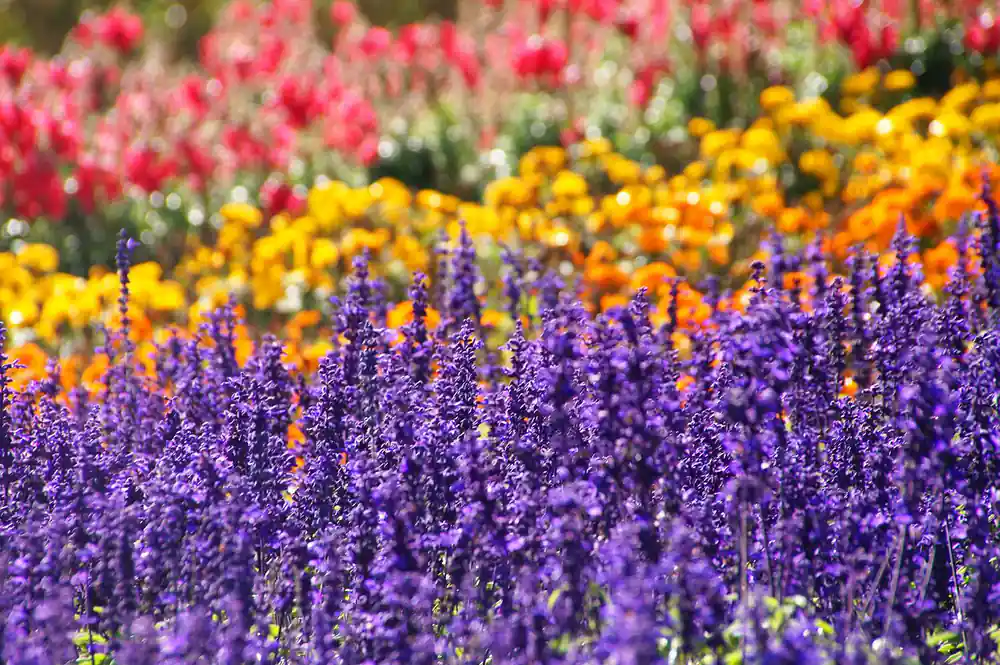
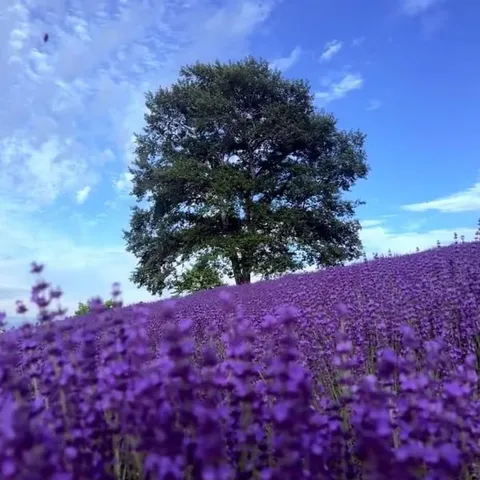
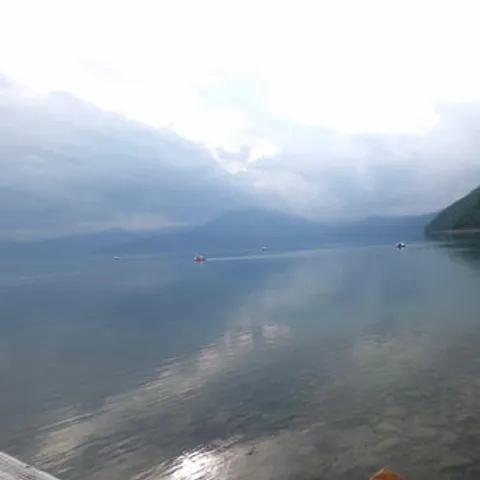
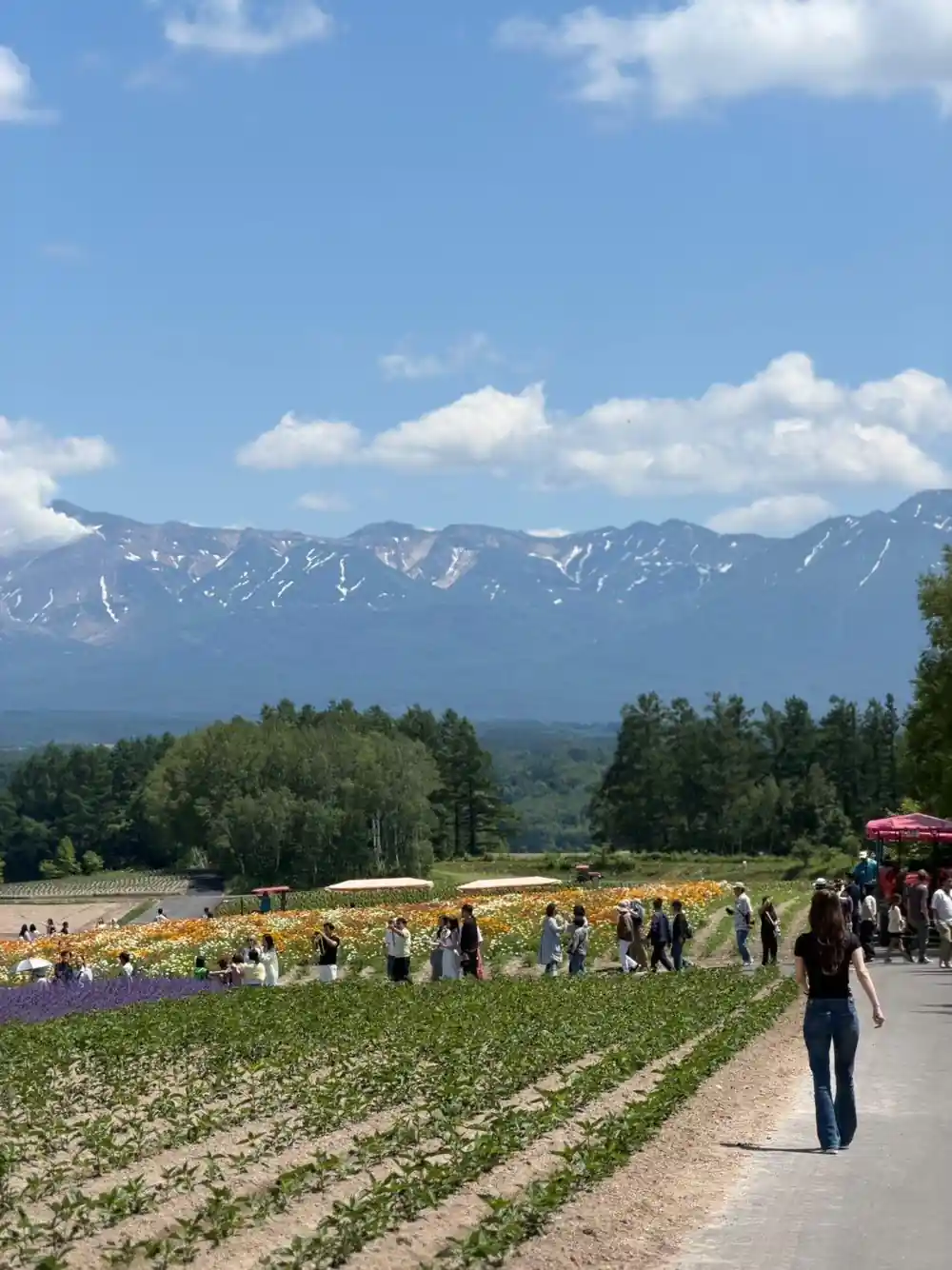
This area is known as "Patchwork Road," where different crops are planted in each plot, forming Biei's iconic scenery.
Patchwork Road: worth the detour
Getting there and around
Weather and what to pack
When a Car Advert Made a Tree Famous
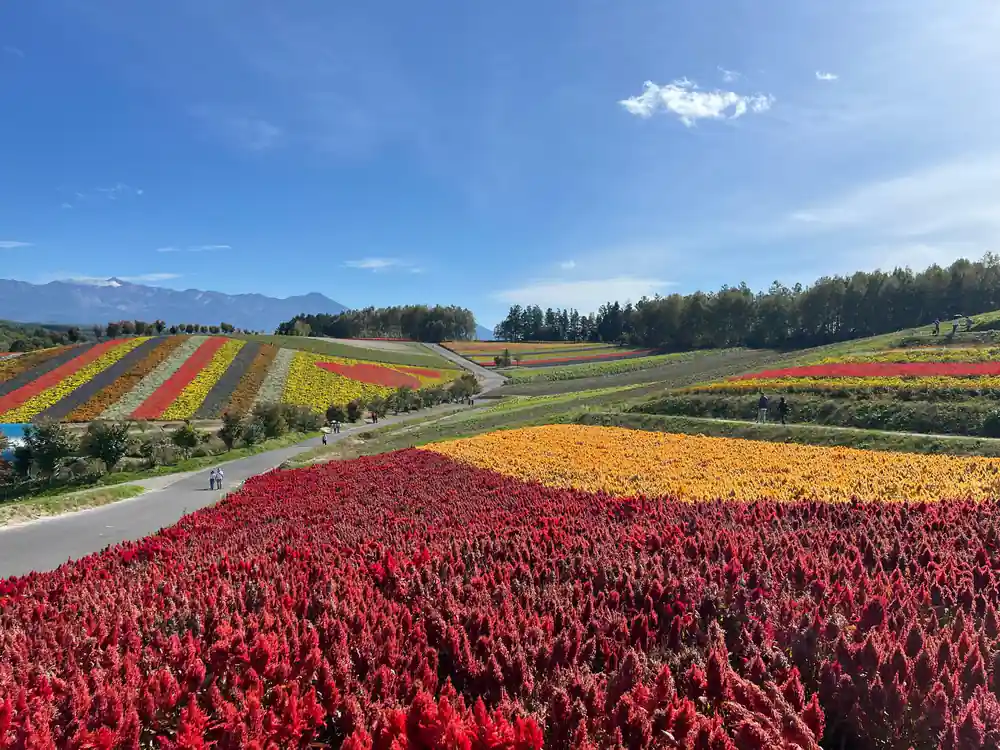
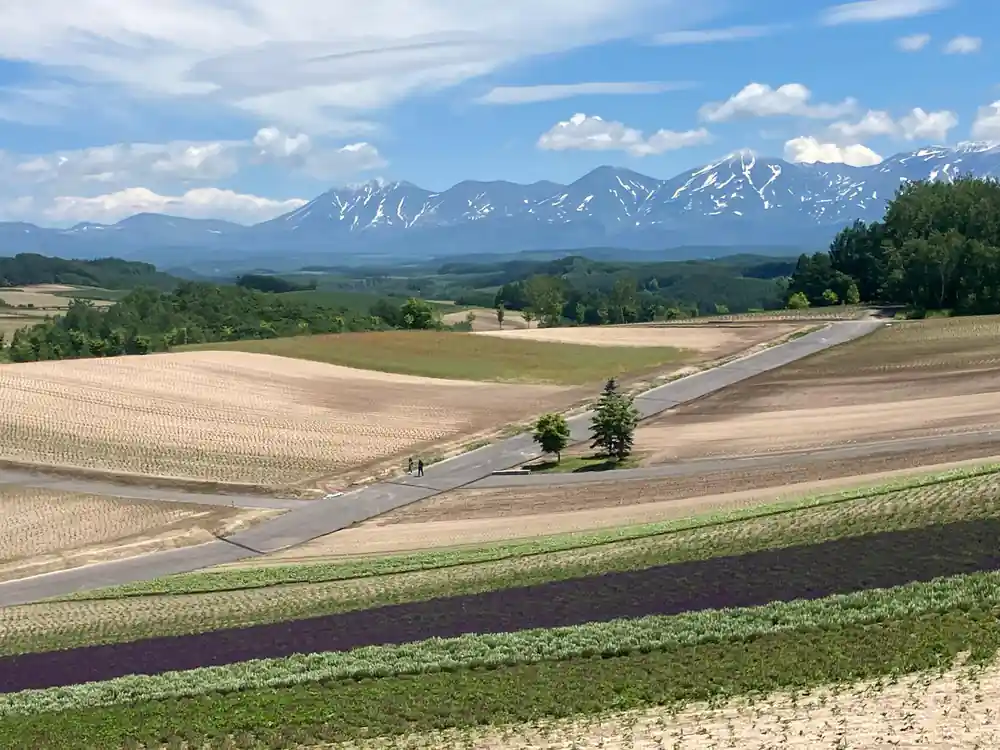
Drive the farm roads above Biei and you will notice them: single trees standing alone in the middle of planted fields, each one a small island of shade in a sea of colour. A local landmark on that road is the Seven Stars Tree, and the fields around it are known as Patchwork Road, where a different crop is planted in every plot, so the land reads as a quilt of stripes and squares.[1] Farmhouses and barns punctuate the plots, and the rows run to the horizon in long, deliberate lines.
The trees were ordinary farm trees for decades. A car advertisement filmed among these hills is usually credited with changing that, and one particular tree became a destination almost overnight. Visitors arrived looking for the exact field in the advert, then for the next tree that appeared in a poster somewhere, and the habit has not stopped since. The fields themselves carry on being farmed, which is the part worth remembering when you slow down to look.
Tobacco Pack Designs Drive Tourism to the Fields
Cigarette packaging played a large part in spreading the name of these hills. Packs printed with the Biei landscape carried the patchwork fields into shops across Japan, and the trees standing in those images became landmarks with names of their own. The Seven Stars Tree borrows its popular name from a tobacco brand, and it still stands in the same field of crops, photographed from the same few angles by a steady stream of visitors.
What the packaging promised is still there to see. Along the farm roads the fields hold golden wheat, purple potato flowers, green bean fields and brown plowed earth, arranged in bands that shift as the season moves on.[11] These farm roads are all public, so you can drive, cycle or walk them, but the crops beside them belong to somebody and should be treated that way.[11] In winter the pattern disappears under snow; Furano received 158 cm of cumulative snowfall in the first two weeks of December, on top of 45 cm that fell in November.[12]
Bands of colour on the hills above Biei, where each plot holds a different crop.
A Photographer's Blue Pond Image Circles the Globe
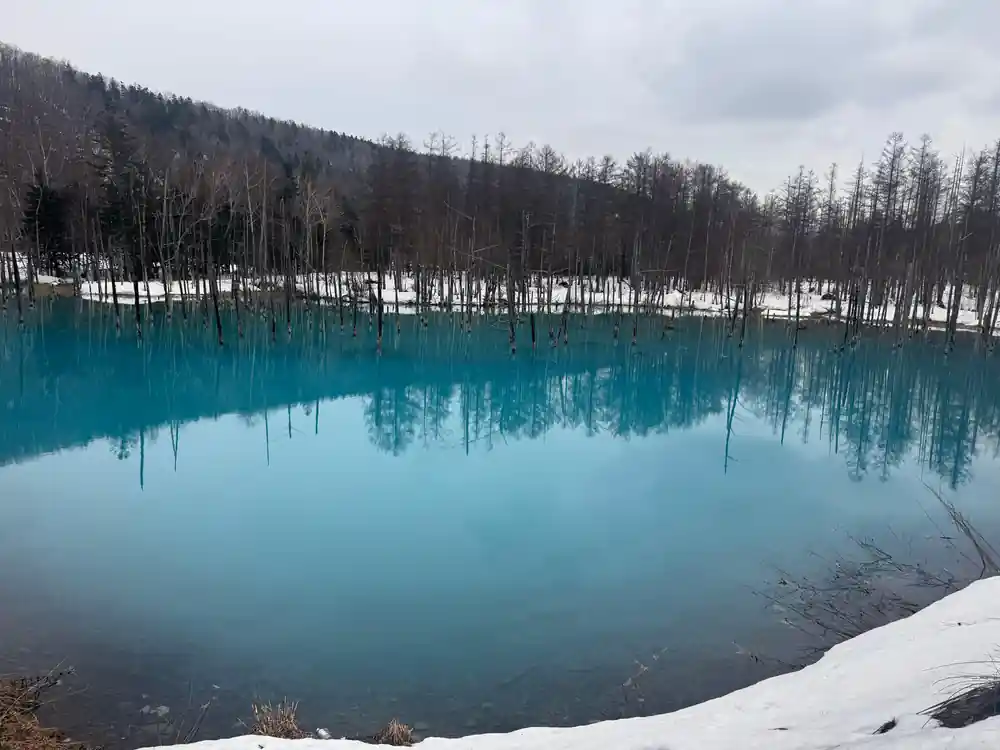
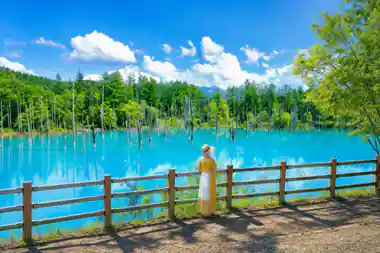
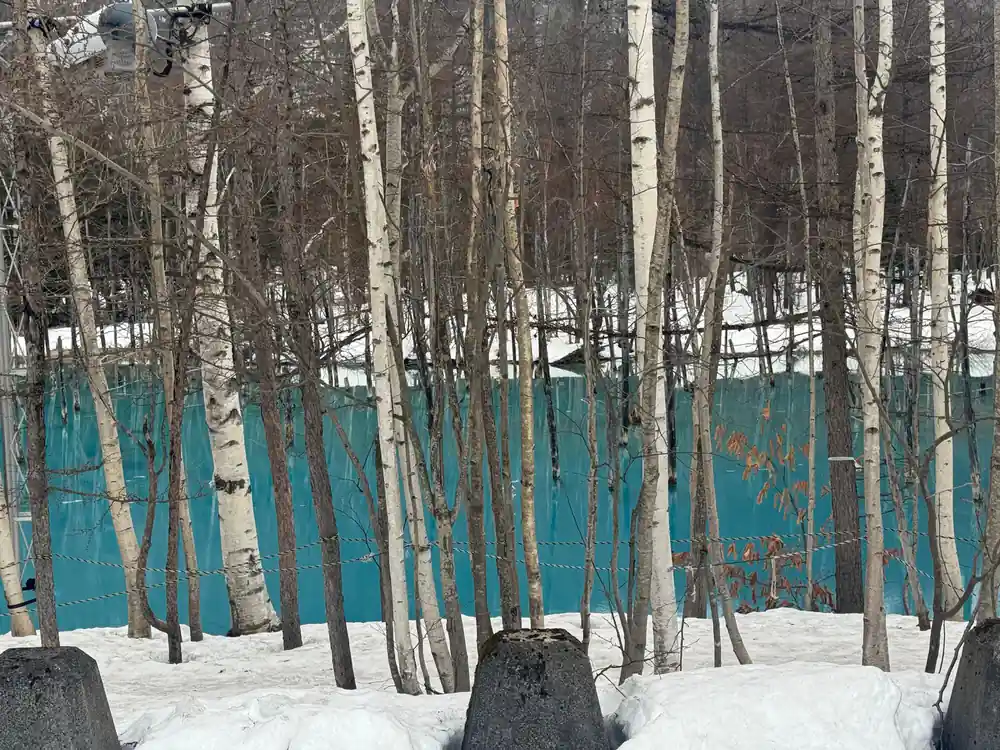
The Blue Pond is a short drive from the tree fields and looks like something painted rather than photographed. It exists because emergency erosion-control dams backed up water after the December 1988 eruption of Mount Tokachi, and the water that gathered behind them became the pond.[4] Aluminium colloids suspended in that water scatter light, and the effect is the turquoise surface that carried the pond's name far beyond Hokkaido.[4] The colour is not a trick of editing; it is what the water does in ordinary daylight, though it shifts with the weather and with the angle you look from.
Above the pond stands Mount Tokachi, 2,077 meters high, the volcano at the start of that story.[13] A little way off, groundwater seeping from the rock face plunges about 30 metres to the river below at Shirahige Waterfall.[14] Both the Blue Pond and Shirahige Waterfall appear among the stops on day tours that leave Sapporo.[15]
Early summer is when the water is most often glassy, with new green on the bank behind it, and autumn brings a different palette to the same shoreline. The pond is small and the visit is short, but it tends to be the photograph people remember from the whole trip. Give it a little time rather than rushing to the next viewpoint.
Television Drama Cements Furano's Place in the National Imagination
Furano's name travelled further still through television. A drama series set in these fields, following a family through hard winters and harvests, drew viewers who then wanted to stand in the same places. Lavender was already part of the working landscape: it has been cultivated in Hokkaido since the 1940s.[8] The flower fields that pull in visitors now grew out of a farming industry that was there long before tourism.
Farm Tomita is the anchor of that story. The farm covers 29 hectares, having doubled in size in 2008 with the addition of Lavender East, and it welcomes over a million tourists annually.[7] Lavender blooms from late June to mid-August.[2] July sits inside that window, and the average temperature in Furano in July is 22.1°C, warm without being heavy.[3]
The drama also fixed an idea of Furano in the minds of people who had never been north of Tokyo. It is a farming town with long winters, a small population and a short, intense summer, and the visitors who come for the flowers arrive in the middle of the busiest weeks of the farming year. The lavender is harvested, not just admired, and the rows in every photograph belong to somebody's season of work.
from US$48
The Colored Hokkaido day tour from Sapporo stops at Patchwork Road, Shirogane Blue Pond, Shikisai No Oka and Farm Tomita.[6]
The Christmas Tree and the Limits of Popularity
Then there is the tree known as the Christmas Tree, the one written up as the xmas tree hokkaido drivers slow down for. It is a single spruce standing in a field with nothing else around it, which is exactly what makes its outline so good in a photograph. In summer it is a dark cone against young green; in winter it carries snow on every branch and the field turns white around it.
Fame has a cost here. The lane past the tree is narrow, there is no proper car park, and the field around it is a working crop rather than a lawn. The view is best taken from the verge, on foot, without stepping between the rows. Coming early, or on a weekday outside the flower season, is the difference between a photograph and a queue.
The same advice applies to the other named trees along Patchwork Road. They stand in fields that are planted and cut on a schedule, and the lanes beside them are shared with tractors and local traffic. A few minutes of care keeps the place worth visiting for the next person.
When Pilgrims Become an Agricultural Problem
Numbers explain the pressure. Farm Tomita alone welcomes over a million tourists annually, and the town around it is small: Furano's population is approximately 26,000, including the incorporated communities in the outskirts, while the main municipal area is said to be about 16,000.[7][16] Those fields are planted, weeded and harvested on a schedule that has nothing to do with visitors.
The etiquette is simple. Stay on the public farm roads and the marked paths, do not walk into a crop for a better angle, close gates behind you, and park where parking exists instead of on the shoulder of a tractor route. If you are on a coach tour, the driver and guide know exactly where a bus can stop, and that is often the gentlest way to see the trees.
It also helps to spread out. The famous trees stand within a short walk of one another, and the same few fields take a great many photographs on a summer afternoon. Walking further along the road, or spending time at the flower gardens instead, eases the pressure on the narrowest spots.
Understanding the Patchwork's Real Pattern
The patchwork is not one landscape but several. Shikisai-no-oka, the panoramic flower garden in Biei, covers fifteen hectares of land, with broad bands of colour laid out for walking and photography.[17] The farm roads give you the pattern at eye level instead, and Ningle Terrace, a shopping area in the green forest of Furano, offers a stop among wood cabins once the light fades.[18]
Getting here takes planning rather than luck. Furano is about a two hour drive from Sapporo using the Doo Expressway, and the lanes between the fields are slow and narrow.[5] A coach tour removes the parking problem: the Colored Hokkaido tour from Sapporo runs for 1 day and stops at Patchwork Road, Shirogane Blue Pond, Shikisai No Oka and Farm Tomita, with a break at a local restaurant.[6]
Furano and Biei also sit within reach of the Hokkaido ski resorts, and winter changes the same fields completely. Furano received 158 cm of cumulative snowfall in the first two weeks of December, on top of 45 cm that fell in November.[12] The hills that hold flower fields in high summer carry a different kind of visitor once the roads turn white.
From-prices for Sapporo day tours
GetYourGuide from-prices in US dollars, from listings[6],[9],[19],[10] and[20].
From-prices in US dollars for Sapporo day tours
GetYourGuide from-prices in US dollars from listings[6],[9],[10] and[19]. Child rates are not stated in the listings.
When to time your Patchwork Road trip
Plan a Patchwork Road day
Check the bloom dates
Lavender blooms from late June to mid-August, and summer trips can aim for that window.[2]
Choose a car or a coach
Furano is about a two hour drive from Sapporo on the Doo Expressway, and a coach tour takes away the parking problem.[5]
Start early
Mornings are quieter on the hills and the light is softer; by midday the popular viewpoints fill up.
Stay out of the crops
Farm roads are public for walking and cycling, but every plot beside them is somebody's crop.[11]
Dress for the day
July in Furano averages 22.1°C, which is comfortable, though the hills can be breezy.[3]
Ride from Sapporo to Patchwork Road, the Blue Pond and Farm Tomita
from US$48Reserve now & pay later