What to remember
- A coach day from Sapporo with two starting location options, taking in Patchwork Road, Shirogane Blue Pond, Shikisai no Oka, a restaurant and Farm Tomita.[1]
- The pond was created when emergency erosion-control dams backed up water after the December 1988 eruption of Mount Tokachi.[2]
- Shikisai no Oka is a panoramic flower garden in Biei covering fifteen hectares,[3] and Farm Tomita is 29 hectares, welcoming over a million tourists annually.[4]
- Lavender starts blooming from late June to mid-August,[5] and the average temperature in Furano in July is 22.1°C.[6]
- The tour is listed from US$48 and rated 4.56 from 122 reviews, with free cancellation up to 24 hours in advance for a full refund.[1]
- Top choice Furano, Biei and Blue Pond from US$48 Duration1 day[1]Rating4.56 from 122 reviews[1]Guide languagesEnglish, Chinese, Japanese, Korean[1]Stop listPatchwork Road, Blue Pond, Shikisai no Oka, Farm TomitaCancellationFree cancellation 24 hours ahead[1] Check availability
- Cape Kamui and Otaru from US$56 Duration10 hours[7]Rating4.55 from 87 reviews[7]Guide languagesChinese, English, Japanese[7]Stop listCape Kamui, Otaru Canal, Shiroikoibito ParkCancellationFree cancellation 24 hours ahead[7] See this tour
- Biei and Furano Flower Sea from US$43 Duration10 hours[8]Rating4.76 from 51 reviews[8]Guide languagesChinese, English, Japanese, Traditional Chinese[8]Stop listBiei, Furano, Shikisai no Oka, Farm TomitaCancellationFree cancellation 24 hours ahead[8] See this tour
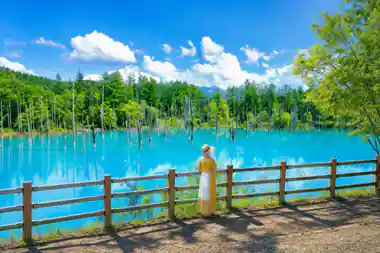
The December 1988 eruption sent volcanic mudflows down the Biei River, forcing emergency erosion-control dams whose backed-up water became the pond. Aluminium colloids suspended in the water scatter light, producing the distinctive turquoise hue seen in Shirogane Blue Pond.
Is this the day to book for Biei and Furano?
Pre-booking checklist
What a Furano and Biei Day Actually Looks Like
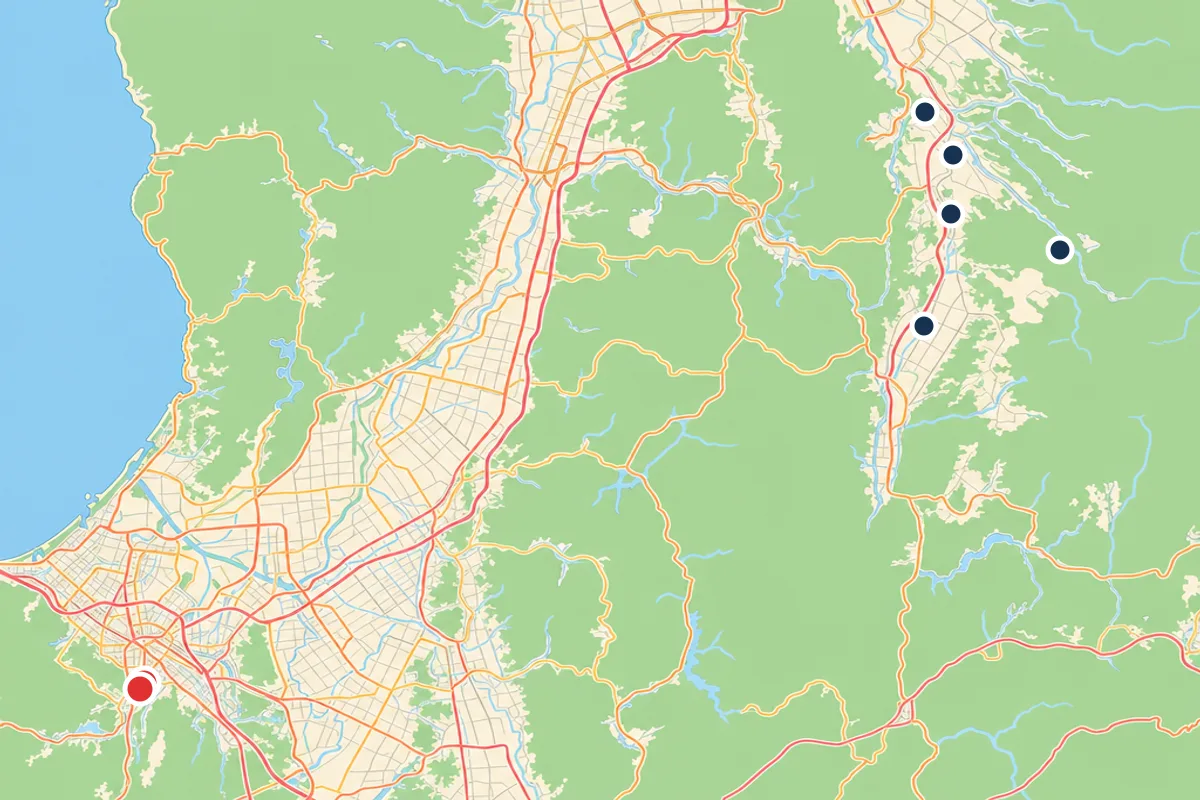
The tour booked from this site runs as a coach day out of Sapporo, with two starting location options and a live guide working in English, Chinese, Japanese or Korean.[1] The order of the stops makes good sense on a map. Patchwork Road in Biei comes first, then Shirogane Blue Pond, then Shikisai no Oka, then a local restaurant for the meal break, and finally Farm Tomita before the coach turns back toward the city.[1] The day finishes at two drop-off locations.[1] The listing gives the overall length as a single day and points you to check availability for starting times.[1]
In practice the day has a rhythm of short bursts outdoors and longer stretches in the seat between them. If you have been comparing blue pond tickets with booking a coach tour, it helps to know that this listing is a coach day with two starting location options and two drop-off locations.[1] Wear something you can peel off in a warm bus and pull on again in a cool field, and keep a small bag with water and a light rain jacket so you never have to dig through luggage at a stop.
Shirogane Blue Pond: What to Do When You Arrive
The Blue Pond exists for a very specific reason. The December 1988 eruption sent volcanic mudflows down the Biei River, forcing emergency erosion-control dams whose backed-up water became the pond, and aluminium colloids suspended in the water scatter light, producing the distinctive turquoise hue seen at Shirogane Blue Pond.[2] Dead larch trunks still stand upright in the water, and the colour shifts with the light, the weather and the season. It is a compact site rather than a long walk, so the pleasure is in looking slowly rather than covering ground.
Photographers usually want two frames here: the wide view from the far end, where the trunks line up against the water, and a closer one where the surface throws the trees back at you. In the middle of the day the light is even, which suits colour more than drama. If you are coming by car, blue pond Hokkaido parking is part of your planning; on a coach day the whole group simply steps out at the stop. Step off, walk down, and use the whole of your time here rather than the first two minutes.

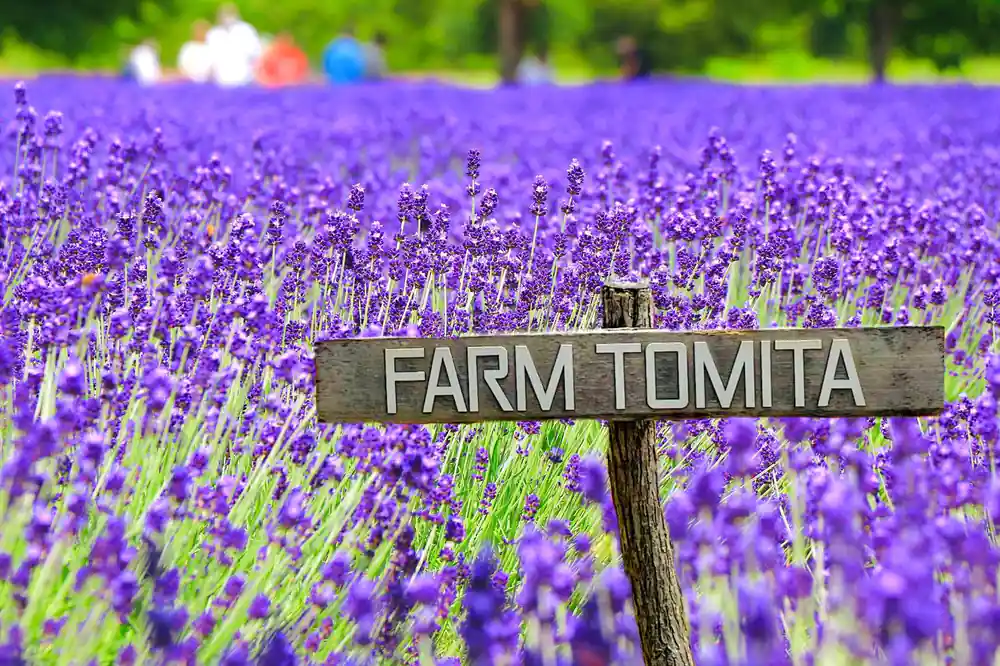
Rows of lavender at Farm Tomita, with the hills of Furano rising behind them.
Shikisai no Oka: A Panorama Above Biei
Shikisai no Oka is a panoramic flower garden in Biei that covers fifteen hectares of land.[3] The beds are laid out in long stripes across a hillside, so the view keeps changing as you climb, with each band of flowers sitting against the next in blocks of colour. From the upper ground you look out over the fields toward the hills, which is the photograph nearly everyone comes for. It is a working garden with paths, and the natural route is up one side and down the other, which is also a neat way to use the time.
Farm shops here sell lavender goods, soft cream and produce from the surrounding fields, and there is usually something in season worth trying. If you are travelling with children, the pace suits them, since there is space to move and no long trail to negotiate. Watch the clock rather than the crowds: groups fan out across the hill and then bunch up again near the entrance, which is where the coach waits.
Farm Tomita: Lavender, Colour and a Coffee Stop
Farm Tomita anchors the afternoon. As recently as 2008 the farm was almost doubled in size to 29 hectares with the addition of Lavender East, and it welcomes over a million tourists annually.[4] Lavender starts blooming from late June to mid-August, and Hokkaido has cultivated the crop since the 1940s.[5][9] The layout is compact enough to cover on foot, with fields, sheds and shops close together, so even a short stay feels complete.
The practical move is to walk the fields first, while the light is good and the paths are quieter, then spend whatever is left on the shops and a lavender soft cream. There is a lot to look at and a lot to buy, and it is easy to lose much of your stop in the first shop you enter. Decide before you arrive whether this stop is about photographs or about the farm itself, and let the other one go if time runs short. The coach parks close by, so getting back is quick once you have had enough.
from US$48
A full day from Sapporo with Blue Pond, Patchwork Road, Shikisai no Oka, a local restaurant and Farm Tomita on the stop list.
Patchwork Road and the Restaurant Break
Patchwork Road takes its name from the way different crops are planted in each plot, forming Biei's iconic scenery.[10] Depending on the week, the views along these farm roads take in golden wheat, purple potato flowers, green bean fields and brown plowed earth, with farmhouses and barns as punctuation.[11] The roads are public, and the view shifts constantly as you move along them.[11] On this itinerary the stop comes first, before the pond.[1]
The restaurant break sits between Shikisai no Oka and Farm Tomita on the stop list.[1] It is not a stop worth planning in fine detail: order as soon as you sit down, eat at a steady pace, and skip the long dessert if the coach is leaving on time. If you would rather graze, buy something from a farm shop at one of the flower stops and treat lunch as a short break. Either way, be back at the coach a few minutes early, because the group leaves together.
Why the Pace Shifts with Season and Traffic
Furano is about a two hour drive from Sapporo using the Doo Expressway between Sapporo and Mikasa.[12] Add summer weekend traffic, farm vehicles on the back roads and a crowded car park on a busy morning, and the shape of the day can change from one departure to the next. The listing gives the tour as one day and points you to check availability for starting times.[1] Free cancellation is offered up to 24 hours in advance for a full refund, which leaves you room to move if the forecast looks grim.[1]
Weather matters in a quiet, practical way. The average temperature in Furano in July is 22.1°C, warm enough for shirt sleeves and cool enough to keep walking.[6] Winter is a different world: Furano received 158 cm of cumulative snowfall in the first two weeks of December one season, on top of 45 cm that fell in November.[13] Whatever the season, layers beat one heavy coat, and shoes with grip are worth more than style on wet paths and gravel car parks.
How to Plan When Your Time Is Tight
If you have one free day in Hokkaido, this loop is built to sweep up the headline sights: the coloured hills, the blue water and the flower farms, all on a single coach trip. That also means each stop is a window rather than an afternoon. Before you step off anywhere, decide what matters most, whether that is a particular photograph, a purchase or simply standing still for a few minutes, and do that first. Everything else is a bonus.
Booking early helps during the lavender weeks, when the fields are at their fullest.[5] The listing shows a price from US$48 and a rating of 4.56 from 122 reviews, with reserve now and pay later and free cancellation up to 24 hours in advance for a full refund.[1] If the pond is the thing you care about most, this itinerary puts it in the middle of the day rather than at the very end. If you would rather add a waterfall to the same area, other day tours nearby list Shirahige Waterfall among their stops.[14]
How long other Sapporo day tours run
Biei and Furano day tours, from-prices
Amounts are the from-prices in US dollars shown on each GetYourGuide listing:[1][14][17][18].
When the Furano and Biei fields look their best
How to use each stop
Blue Pond
Walk down to the water, take in the colour and the standing trunks, then use your last minutes for the view from the far end of the pond.
Shikisai no Oka
Head uphill first for the wide view across the beds, then come down through the lower fields on the way back to the meeting point.
Farm Tomita
See the lavender fields while the light is good, then use what is left for the shops, a soft cream and the toilets.
Patchwork Road
Mostly seen from the coach window, so keep the camera ready and watch how the colours change plot by plot.
The lunch break
Order quickly at the local restaurant, eat at a steady pace and leave time to find your way back to the coach.
Spend a day between the flowers, the hills and the blue water
from US$48Reserve now & pay later